Understanding hip anatomy
The hip is a ball-and-socket joint, designed to allow smooth movement. The "ball" is the top of the thigh bone (femur), and the "socket" is a curved part of the pelvis called the acetabulum. Normally, the ball fits securely inside the socket. In hip dysplasia, however, the socket is too shallow or not positioned correctly, which prevents the femoral head from being fully supported.
Because the joint doesn't fit together properly, extra stress is placed on the cartilage and labrum, tissues that cushion and stabilize the hip. Over time, this can lead to pain, stiffness, restricted activity and early arthritis. Hip dysplasia is a common cause of hip pain and arthritis in people under 50.
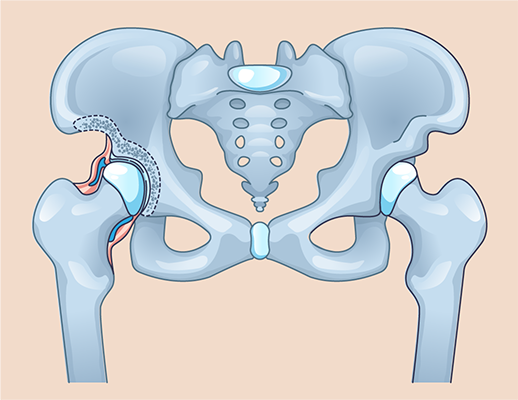
Hip joint on left is normal, while hip joint on right has a shallow socket requiring PAO surgery
Who is eligible for PAO surgery
PAO is an option when patients are old enough that their pelvic bones have stopped growing but still young enough that they haven't developed osteoarthritis in the affected hip joint. Most patients are between the ages of 12 and 40.
In addition, the curvature of the hip socket should match the curvature of the femoral head, so the two can function well after the surgery.
Evaluation for PAO
To determine if your child may benefit from PAO, the doctor will perform a physical exam and ask about your child's pain, symptoms and daily activities. The doctor will check how well the hip moves, see if certain movements cause discomfort and observe how your child walks.
Imaging tests are an important part of the evaluation and may include:
These tests help the doctor get a detailed look at the hip joint, including the bones, cartilage, labrum and overall hip structure.
PAO surgery
Before surgery, your child will receive general anesthesia so they'll be asleep and comfortable during the procedure.
During the surgery, the surgeon uses real-time X-ray imaging to carefully guide the procedure. Small cuts are made around the hip socket to separate it from the surrounding pelvic bone. The hip socket is then repositioned to better cover the top of the femoral head, so the hip joint is more stable. Once the optimal position is achieved, several screws are inserted to hold the hip socket securely in place while the bone heals. In most cases, these screws remain in place permanently unless they later cause discomfort.
If both hips require surgery, these procedures are performed separately, about 9-12 months apart.
Recovering from PAO surgery
Most patients stay in the hospital for 2-4 days after surgery.
Physical therapy typically begins the day after surgery, with a focus on getting your child up and moving with the help of crutches or a walker. During the hospital stay, the care team will closely monitor pain control and recovery to ensure your child is comfortable before going home.
After discharge, your child will continue outpatient physical therapy to improve their strength and range of motion. We'll monitor how well the bones are healing and your child's overall recovery though follow-up visits to the clinic. Most patients are able to return to their previous level of activity and function over time.