



























Sleeping
By 6 months of age, most babies are capable of sleeping for at least six to eight hours at night. If your baby still wakes up several times a night, these sleep patterns are habits that most likely will continue for many months unless you make some changes.
Think about whether or not you will be content to have your baby continue his or her current pattern of nighttime waking. If not, consider the following:
- Your baby does not need to feed during the night. Most babies wake up at night because they are used to eating, but they do not need the nighttime calories to grow properly.
- If you are breast-feeding, try nursing from just one side at night, to decrease the amount of milk your baby gets from nighttime feedings.
- If you are bottle-feeding, consider giving your baby a bottle of water instead of formula at night.
- All babies (and adults) wake up at night. Babies may make noise or squirm, but they need an opportunity to help themselves fall back asleep. Otherwise they will never learn to do it on their own.
To help your baby learn to settle down and go back to sleep on his or her own:
- Encourage your baby to become attached to a "lovey," such as a teddy bear or blanket.
- Have a soothing, 5- to 15-minute bedtime routine. This may include a book, song and gentle rocking.
- Put your baby to bed while still slightly awake. This way, your baby will know where she or he is during an awakening.
- Try using a night light.
- Allow your baby to cry a little before falling asleep.
- Don't start any new habits in the middle of the night that you are not willing to continue for many months.
- Don't pick up or feed your baby during the night.
- Speak softly to your baby and let him or her know that you are there, but it is time to go to sleep.
Even babies who are sleeping through the night now may begin waking up later, when they are around 8 to 9 months. This may be because they can pull up to standing in the crib, or because they're now aware that you exist even when they can't see you, and they call out to you to make you come.
Feeding
Breast milk or formula will continue to provide nearly all of your baby's nutritional needs for the first year of life. If you are using formula, choose iron-fortified formula. If you are breast-feeding, continue taking your prenatal vitamins and give your baby 400 units of vitamin D each day.
Hold your baby during feedings. Do not prop up the bottle or put your baby to bed with a bottle, as this can lead to tooth decay and ear infections.
At about 6 months of age, you may notice that your baby can sit upright and reach out for objects, such as food on your table. When your baby is able to sit and reach, his or her swallowing and chewing muscles also are maturing, meaning your baby is getting ready to eat solid foods.
Please see FAQ: Feeding Your Baby Solid Foods for more information.
Safety
Baby-Proofing
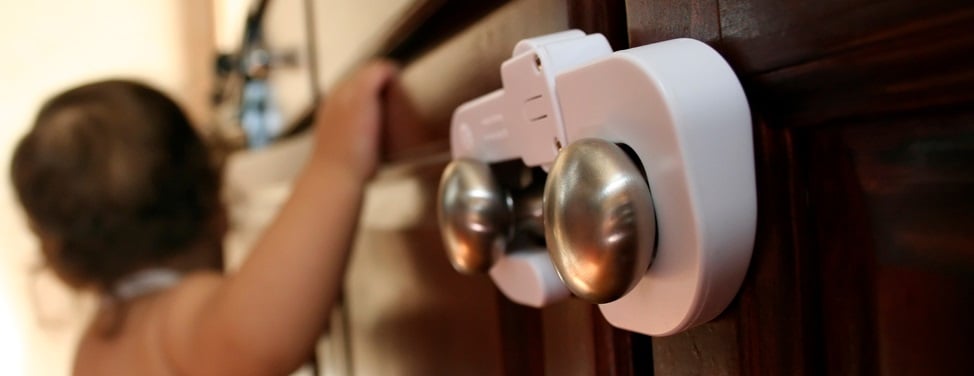
Your baby is going to become more active and will soon begin to scoot or crawl around the house. Start looking around your home now to identify and correct any potentially dangerous situations for your baby. Here are some tips for making your home safer:
- Hide or cover electrical wires — babies love to suck and chew on wires, which can cause serious mouth burns.
- Cover electrical outlets. Many different kinds of baby-proof covers are available.
- Place plants up high so your baby can't touch or eat them. Many house plants can be dangerous to babies.
- When friends come over, ask them to put their bags and backpacks up high so your baby can't get into anything dangerous.
- Start the habit of keeping your bathroom door shut tightly.
- Turn the hot water temperature in your home down to 120° F.
- If you have a toy hanging across your baby's crib, remove it now so your baby won't get caught when he or she begins sitting and standing.
- Consider making one of your kitchen cabinets or drawers a place where your baby can find safe pots, pans, plastic tubs, spoons and plastic spatulas. Your baby will enjoy banging things together and taking things in and out.
- Set up a special shelf or place where your older children can keep their toys out of the baby's reach. This is especially important for small toys that pose a choking hazard to your baby, like Legos. It also can be helpful to let older children know they are not expected to share all of their toys, just as you do not share everything in your home when you have company.
- Look under your sinks and move cleansers, detergents and other cleaning supplies to a higher, safe place.
- Gate stairs or other dangerous places.
- Do not put your baby in a walker — they do not help children learn how to walk and can be very dangerous.
For additional ideas, please see Childproofing Your Home.
Sunscreen
When your baby is 6 months old, you can begin applying sunscreen or sun block when your baby is out in the sun. However, it is still better to keep your baby covered or in the shade most of the time.
Fluoride
If you do not use tap water, please talk to your doctor about whether you should be giving your baby fluoride.
Immunizations
Your baby will receive the third set of immunizations at the 6-month checkup. The next set of immunizations will be at 12 months, when your baby may receive several immunizations, including Hemophilus influenza (HiB), Pneumococcus (Prevnar) and Hepatitis A. Varicella (chicken pox) and measles, mumps and rubella (MMR) vaccinations may be given at the 12- or 15-month visit.
Used by permission of Jane E. Anderson, M.D.