



























The early elementary years are exciting for both children and parents. Children this age are exploring their community and world, developing social relationships, learning to read, and beginning to process information to solve problems. Parents are as important as ever — your child needs your encouragement, your teaching, your discipline, and your modeling of social interactions and decision making.
Nutrition
Children this age are still picky eaters and often want the same thing for breakfast, lunch and dinner. Parents can encourage children to try different foods by taking advantage of their creativity:
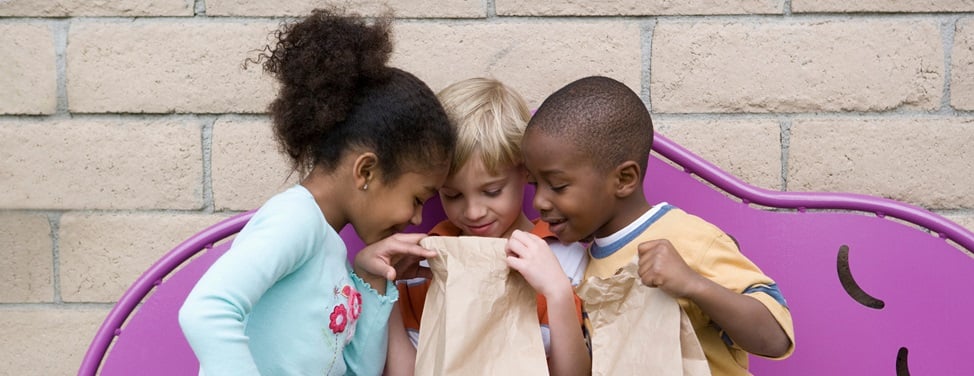
- Let children make their own sandwiches, offering a variety of sandwich makings.
- Let your child help you cook. Cooking is a learning experience for kids — they can begin to read recipes and measure ingredients, and can experiment with changing ingredients. Children are much more likely to eat something they've helped prepare.
- Serve breakfast foods like eggs or pancakes for dinner, and serve a dinner food like tacos for breakfast. Children enjoy a change of routine and will be more likely to try different foods.
- Let your child see you eating a variety of fruits and vegetables.
Some research shows that Americans need additional vitamin D. Consider giving a multivitamin. Children also need about 1200 mg of calcium daily. That's about four servings of calcium-rich foods such as milk, yogurt or broccoli.
The whole family should limit intake of fried foods, fatty foods and junk foods. Since you control the shopping list, choose your groceries carefully. Don't buy sodas, chips, candies, cookies or cupcakes. Nutritious snack alternatives include fresh fruit, popcorn, pretzels, cheese and crackers, string cheese, raisins, nuts, carrot sticks, yogurt and dried fruit.
Family Dinnertime
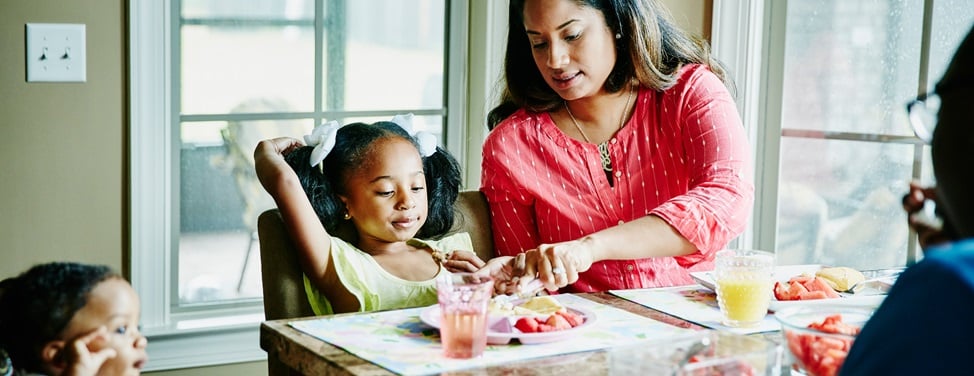
One of the best family traditions is sitting down together for meals. We especially encourage families to eat dinner together. A family dinner allows the family to regroup and share the day's events with each other. You can use this time for fun, sharing experiences, talking about feelings and emotions and discussing problems. However, it is not a time for discipline. Mealtimes should be relaxing. It's also a good idea to turn off the TV during mealtimes to encourage everyone to talk.
Research has shown that teenagers are less likely to participate in high-risk behaviors if they have shared mealtimes with their parents.
Dental Care
Your child should have regular dental visits and should be brushing and flossing at least twice a day. Your child's 6-year molars are probably in place and are the most likely place for cavities to form. Make sure your child brushes carefully in the back of his or her mouth. You may want to ask the dentist about using sealants to prevent cavities in the molars.
Toileting
Some 6- to 8-year-olds still have accidents at night and may wet their beds several times a month. Your child should gradually have fewer accidents as he or she grows and the nervous system matures. If your child has accidents during the day, either urine or stool, or has started having accidents after six months of staying dry, please let your child's doctor know. Also alert the doctor if the nighttime accidents interfere with your child's life or are an issue for the family.
Sex Education
Most 6- to 9-year-olds have already been exposed to information about sexual activity and reproduction and will openly talk about it at school. If you haven't already talked with your child about how babies are made, this is certainly the time to begin.
The elementary years are usually a time of activity and energy, and children this age are not very interested in issues related to sex. Boys and girls usually play separately and don't want to be with members of the opposite sex — the "cootie factor" is in effect. If you can, respect your child's choices of playmates and don't encourage co-ed activities if your child isn't interested.
School
Children are learning the routines that accompany going to school. They should be comfortable leaving their parents and participating in school activities. If your child has difficulty separating from you or interacting with friends at school, please talk to your child's pediatrician.
School is now centered on academic learning rather than just developing social skills. Children this age are learning to read and do math problems. Reading is especially important, as it is the basis for much of the child's future learning. It's important to identify any problems early so your child can receive help.
The following is a general guideline:
- By the end of first grade, your child should be able to read a phonetic word such as "peppermint."
- By the end of second grade, your child should be able to read words with consonant blends, such as "Washington," "churches" and "brushing."
- By the end of third grade, your child should be able to read non-phonetic words such as "flight," "brought," "enough" and "appreciation."
- By the end of fourth grade, your child should be able to read most words in a magazine.
In third and fourth grade, schoolwork becomes more difficult as your child must process previously learned information to solve problems. Students will have to read math problems and write essays. Learning difficulties may become apparent at these grade levels. Please talk with your child's teacher or pediatrician if you have any concerns.
Bullies
Children may be bullied or threatened at school. Please talk with your child frequently and make sure he or she feels safe at school. There are many resources for families and children who have experienced bullying, so please talk to your child's pediatrician if this is a concern.
Homework
Most elementary-age children look forward to having homework and being like the older kids. Unfortunately, however, homework can often cause arguments in families.
Some simple guidelines for encouraging your child's learning:
- At this stage, the main purpose of homework is to teach your child responsibility and organizational skills. You can show your child how to keep notebooks and backpacks organized, but your child should be doing his or her own homework.
- Parents are responsible for making sure their child has:
- Time to do homework
- A place in the home to do homework
- The needed supplies to do homework
- As children grow and mature, they will gradually become responsible for making sure they have the supplies and time in their schedules to do homework.
Homework Without Tears is an excellent resource.
Television, Computers and Media
Children learn so much from television and computer games, and much of what they learn is unhelpful — or even harmful. They may see violent acts that go unpunished, and will often see sexual material that is inappropriate for their age. They will also be spending time sitting when they should be exercising, reading, exploring, creating or just daydreaming.
Children who watch more than one hour of television a day are more aggressive and less creative. They read less and may have more difficulty paying attention in school. They may gain weight because they're not exercising enough or they eat more food while watching television.
Some guidelines for TV and computer use:
- If your child is watching TV — Be there with your child to discuss the values portrayed in the program and to help your child choose the programs carefully.
- If your child plays video or computer games — Make sure you know the content. Video games are often graphically violent and promote bloodshed.
- Children learn from advertisements — Be there with your child to discuss your value system and to help your child question the advertisers' messages. Children enjoy realizing they can outsmart the advertisers by not listening to their messages.
- If your child is having difficulty paying attention in school — It is especially important to limit screen time, and possibly eliminate it on weekdays.
- Do not allow a TV or computer in your child's bedroom — It is more difficult to monitor programs and internet use. Keep TVs and computers in a central location where you can see what your child is doing.
Chores
Performing work that is helpful and appreciated shows children that they are important members of the family. Give your child specific tasks that are important to the running of the household. Setting and clearing the table, sorting and folding laundry, feeding pets and taking out the garbage are all ways that your elementary-age child can help out and develop self-esteem from a job well done.
Sports and Outdoor Activities
Research is revealing that spending free, unstructured time outside in nature benefits children in many ways. Children often do better in school, are more creative and have better mental health.
Children also benefit from exercise and team sports. Children who participate in sports have better self-esteem and do better in school. San Francisco Parks and Recreation offers many programs, as do local sports associations.
Play
All children need to have unscheduled free time. Unfortunately, many children today have so many scheduled activities that they do not have any time to just play. Playtime allows children to:
- Experience boredom and think creatively of ways to resolve it
- Use their imaginations
- Creatively develop games and come up with rules
- Develop decision-making skills
- Experience the joys of childhood in a relaxed way
- Do nothing
Consider eliminating one of your child's structured activities, if necessary, to give him or her the gift of free time.
Teaching Values
Children learn from you every day. You are their best teacher. By watching you, they learn how to talk to other people, how to treat others, how to interact in the family, how to work, how to solve problems and how to deal with emotions. They also learn what you do and do not value.
Money
An allowance is an excellent way to begin teaching your child how to handle money. Some families choose to give their children a small allowance without linking it to chores, feeling it's important for children to know that everyone benefits from the parents' employment. Other families believe children should learn that they earn money by doing work, and give children an allowance after their chores are completed. Some families combine approaches — they give children a small allowance, plus additional money for any extra work.
The most important thing is for parents to show children how to use money — how to save it, how to pay for small items at the store and how to use it to buy gifts for others. As children get older, you may want to increase their allowance while requiring them to have a budget for items they must buy with their own money.
Decision Making
Your child should be given the opportunity to begin making decisions and experiencing the consequences, both negative and positive, of those decisions. There are many decisions a child can help make if you feel it is appropriate:
- Which after-school activities to participate in
- Which restaurant to go to
- What weekend activity to do together as a family
- Which friends to invite over
- How to spend their money
- What clothes to wear
Show your child how to think about decisions:
- Determine what the options are
- Consider every possibility
- Consider the pros and cons of each option
- Choose the best option
- Re-evaluate after you see the results — decide whether or not it was a good choice and what you might do differently next time.
Other Values
What other values do you want your child to learn?
Time Management
- Help your child create a weekly chart of chores or tasks to complete, books to read and so on.
- Make sure your child's life is not overly scheduled. Children also need time to relax, think and daydream.
Friendship
- Allow your child to invite friends over for dinner
- Help your child shop for a friend's gift
- Do something special for your child's friend
Personal Acceptance of Failure
- Admit your mistakes in front of your child
- Acknowledge your feelings, but express the idea that you can try again or learn from your mistake
Expressing Emotions
Emotions are never right or wrong — they are simply feelings. It is our behavior that can be right or wrong. Help your child see the difference. For instance, "I can see you are very angry, but it is not acceptable to kick your brother."
Religion
Some families find a place of worship where they can meet other families who share their values and who can support their family.
Safety
Some safety guidelines:
- Young children don't have the depth perception and quick reaction time that helps adults ride bikes safely. Be careful of where you let your child ride bikes. Never allow your child to ride in areas of busy traffic. Review bike safety rules and make sure your child always wears a helmet.
- Review your family's emergency plans for fire and earthquake. Make plans for what to do should disaster separate your family.
- Teach your child how and when to dial 9-1-1.
- Teach your child basic safety rules of crossing streets, talking to strangers and so on.
- Remind your child to always tell you if someone is touching him or her inappropriately.
Used by permission of Jane E. Anderson, M.D.