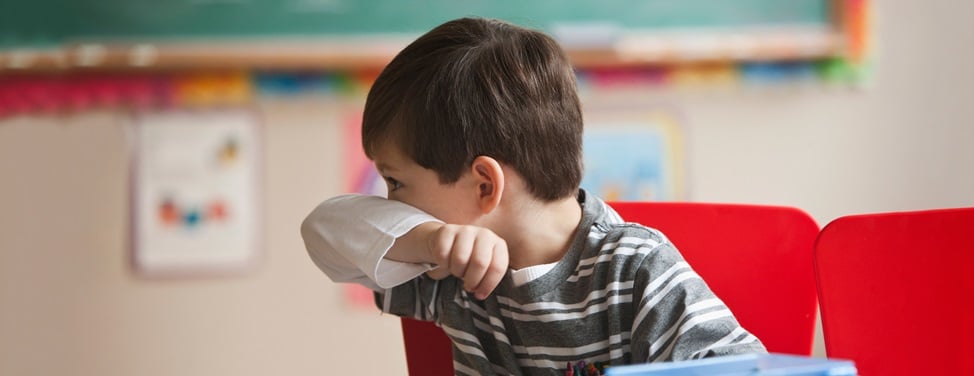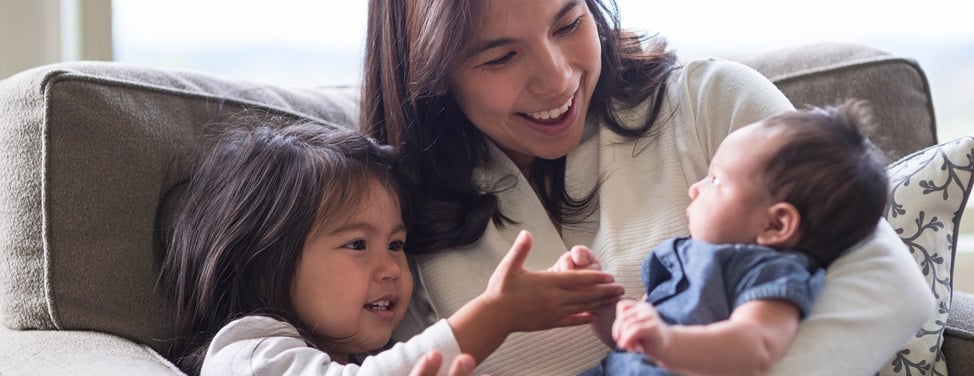




























Two-year-olds are rapidly expanding their knowledge of the world, becoming more competent and developing a sense of gender identity through play and imitation.
Your child will prefer one parent over another. Although this can be a difficult stage for parents, you can view it as part of your child's healthy development. The "desired" parent may feel overwhelmed and trapped, while the "rejected" parent may take the child's behavior personally. Talk together and think of fun ways for the "rejected" parent to spend time with your child, providing the "desired" parent some relief. Soon enough, the roles will be reversed as your child matures.
Nutrition
Your child won't gain much weight this year, so expect his or her appetite to decrease. A few nutrition hints:
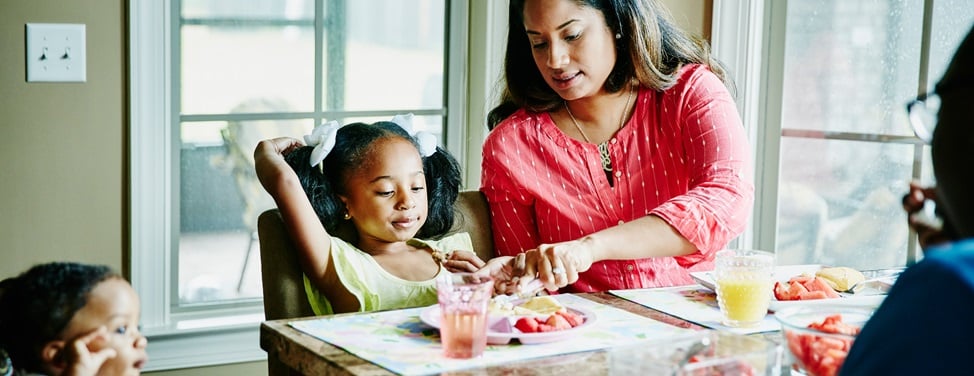
- Develop the habit of eating at least one or two meals a day together as a family.
- Mealtime should be fun — a time to share ideas, experiences and feelings.
- Offer a variety of fruits, vegetables and grains, but expect your child to be picky. Remember that children who see their parents making healthy food choices will learn to do the same later on.
- Consider giving your child a once-daily, chewable multivitamin with minerals.
- Try to avoid too much junk and fast food, fried food and fats.
Dental
Brush your child's teeth at least once a day, especially before bedtime. Please do not use toothpaste with fluoride; if you use toothpaste, buy a children's paste that doesn't contain fluoride.
Your child should see a pediatric dentist between 2-and-a-half to 3 years of age. Children's dental visits are very different these days, and most children enjoy their visit. Reading a book such as The Berenstain Bears Visit the Dentist can help prepare children for seeing the dentist.
Toilet Learning
Many children are toilet trained when they're 2. It is very important to let children decide when they are ready and to encourage their attempts. Never force your child to sit on the potty seat or toilet, as it will only cause more resistance.
If your child is interested, is telling you when it's time for a diaper change and is staying dry for more than two to three hours, you can encourage toilet training by:
- Buying a potty seat.
- Allowing your child to choose big boy/big girl pants with his or her favorite characters.
- Considering giving a reward — stickers, small candy or a toy — for successful attempts.
- Showing your child that stool from the diaper goes into the toilet. You may want to wait until your child is gone before flushing — some children feel they've lost a "precious" part of themselves.
- Leaving the rest of the learning up to your child.
If your child is at all resistant, immediately stop all discussions of toileting and wait until your child shows signs of interest.
Sexuality
During toilet learning, children first become comfortable with their sexuality. The following guidelines can help your child develop a healthy attitude:
- Toilet training will often bring out your own concerns about your sexuality. Make sure you feel comfortable yourself.
- Use the correct words for private body parts — penis, scrotum, labia, vulva. We don't use slang words to describe other body parts, such as eyes, ears and noses, and it's best to also use correct terms for genitalia.
- Begin by casually telling your child that boys and girls are made differently.
- You may want to let your child know that the parts of the body that are covered by underwear are private areas that no one should touch except for the child or parents.
Children may also begin masturbating. This is normal, and it is helpful to respond calmly. You may want to tell your child that while the behavior may feel good, it is private and should be done in a private space, like the bedroom.
During this year, children also develop gender identity through play and imitation. Children play dress-up and try on different roles. Have some old clothes, shoes and hats around for your child to try on.
Language
Your child will rapidly expand his or her vocabulary and learn complex concepts like shapes, counting and time. Two-year-olds should soon be putting two and three words together. Other people should be able to understand your child about half the time.
Children this age try to talk so quickly that sometimes, they will begin stuttering. This does not mean they will stutter later in life. If you do hear your child stuttering, please call your child's pediatrician.
You can help your child's language development by:
- Singing songs — children love repetition and learn this way
- Spending time each day reading to your child
- Giving your child time each day to talk uninterrupted
- Slowing down your speech when talking to your child
- Encouraging your child's imagination
- Limiting television viewing and other "screen time" to less than one hour per day
Discipline
Your 2-year-old is continuing to learn which behaviors are appropriate. At this point, your child should know how to obey you and should be able to sit still in time out. If your child can't or won't do this, it probably indicates that your child does not know how to obey you. You may want to consider teaching time outs again.
Time out tips:
- Offer positive reinforcement, such as stickers, when your child has sat quietly for one to two minutes.
- Use an hourglass timer so your child can see how long he or she needs to sit still.
- Start time out over again each time your child tries to get up or fusses.
Time out can now be used to help your child develop self control. Parents can tell children to think about their behavior during the time out, and that when it's over, they can return to their activities if they're ready to control their behavior. For example, "You can come back to the table when you're ready to not throw the peas."
Parents often notice their children struggling during time out, as they decide whether to stay seated or whether they can control their behavior. Follow time outs with a hug and a reminder that you love your child. Calmly remind your child of the rule and say you know he or she will try hard to behave properly.
Two-year-olds are also developing the concept of consequences. You can encourage this by showing cause and effect. For instance, "If you go outside without a coat, you will be cold" or, "If you color on the walls, I will have to take away your crayons."
Chores help teach children responsibility and help them develop self-esteem as they learn to do a job well. Putting napkins on the table, putting toys away, feeding the pet — all help your child know that he or she is an important member of your family.
Fears
It's normal for children to become afraid of things that didn't bother them previously, such as loud noises or animals. If your child shows fear, use emotion words to name the fear — for example, "I see you are afraid of the dog." Then reassure your child that you're there to take care of him or her. Don't ridicule children for being afraid and don't try to talk them out of their fears — it won't work. Just let them know you will protect them.
Used by permission of Jane E. Anderson, M.D.