



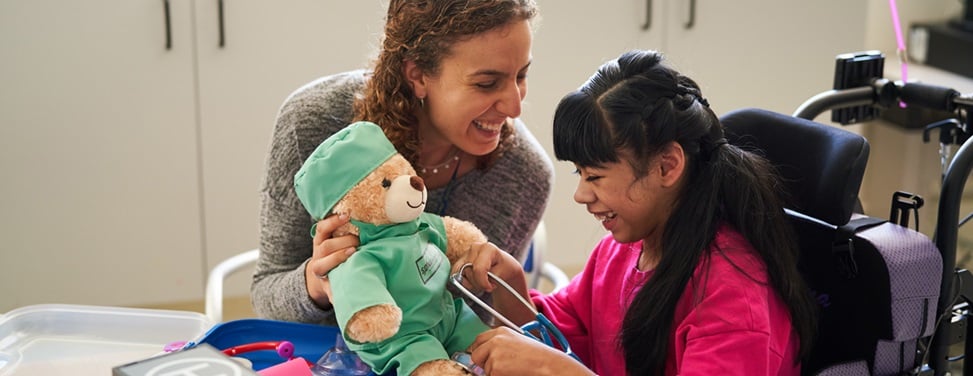






Soothing the soul
Our music therapy program nurtures patients with bedside serenades, rap workshops and more.
Find out more




Here to serve you
Explore our network of care for kids, from the tiniest to teens and young adults.




World-class docs
We'll help you find the best provider for your child.




Stress-free visits
Accommodations. Admission. Discharge. Procedure prep. We've got you covered.




Extraordinary kid care
Our specialists handle conditions ranging from the common to the most rare.




Referrals made easy
Contacts and resources to get your patients to our pediatric specialists




Best in Northern CA
We're ranked #1 in pediatric cancer, heart surgery, cardiology & more.





Wilms tumor is a type of kidney cancer that mainly affects children. The kidneys are two bean-shaped organs that filter blood and produce urine. They're located above the waist, one on either side of the spine.
Also called nephroblastoma, Wilms tumor is the fifth most common childhood cancer and one of the most common abdominal tumors in children. In the United States, about 400 children are diagnosed with the condition each year. Most often these children are under 3, though Wilms tumor can occur at any age between infancy and adolescence. It affects boys and girls equally.
The disease typically occurs in one kidney but occasionally involves both, and it sometimes spreads – usually to the lungs and liver. With treatment, most children with Wilms tumor can be cured.
Generally, the condition causes a painless swelling in the abdomen that parents discover while bathing or dressing the child or while changing diapers. Some children have abdominal pain, loss of appetite, bloody urine, fatigue or weight loss.
If a tumor may be present in your child's abdomen, don't apply pressure to the area. Your child should be handled carefully before and during any tumor evaluation. If the tumor ruptures, cancer cells can spread to other tissues of the body.
To request an appointment, give us a call: (877) 822-4453
In most cases, the cause of this cancer is unknown. It typically develops in otherwise healthy children.
However, about 10% of cases occur in children born with certain conditions, such as aniridia (when the iris, or colored part of the eye, is partly or completely missing) and hemihypertrophy (when an overgrowth of tissue and bone causes one side of the body to be larger than the other). Wilms tumor also is associated with a number of rare genetic disorders, including:
Patients may have a family history of the disease, though this is uncommon.
Children with Wilms tumor may experience a variety of symptoms. The most common include:
Your child's doctor will gather a complete medical history and perform a physical exam. Tests to diagnose Wilms tumor may include:
Imaging tests are usually sufficient to determine whether a child has Wilms tumor. But the diagnosis can be confirmed only by examining cells from the tumor under a microscope. Most often a tissue sample is obtained during surgery to remove the tumor. But if doctors aren't sure the cancer is Wilms tumor or can't completely remove the tumor, they may perform a biopsy, a procedure to take a very small piece of the tumor for microscopic analysis.
Part of the diagnostic process involves determining the cancer's stage, which helps doctors know how it's likely to behave and which treatment would be most effective. The stage is based on how much the cancer has spread and how the cells look under a microscope. The stages of Wilms tumor are:
The main techniques for treating Wilms tumor are surgery, chemotherapy and radiation therapy. Most children with Wilms tumor have more than one kind of treatment. The specific plan depends on the cancer's stage and the child's overall health.
Treatment for Wilms tumor often begins with surgery to remove all or part of the affected kidney. (Bear in mind that people can live and be healthy with one kidney.) The surgery is also typically used to confirm the diagnosis.
The goal of surgery is to remove the entire tumor in one piece so that cancer cells don't spread to the abdomen. When this isn't possible, the surgeon may recommend other treatments first to shrink the tumor enough to be removed.
Depending on the nature of the tumor, the surgeon may perform one of the following operations:
Chemotherapy is using drugs to kill cancer cells. It's called a systemic treatment because the drug enters the bloodstream, travels throughout the body, and can kill cancer cells in many tissues and organs.
Chemo drugs for Wilms tumor are usually given either through an intravenous (IV) catheter (a thin, flexible tube) placed in a vein or through a central venous catheter, which is placed in a large blood vessel during surgery. The specific drugs, doses and length of treatment depend on the stage and other characteristics of the tumor and on the child's age.
Chemo may be given before surgery to shrink the tumor, making it easier to remove. Or it may be given after surgery to destroy any remaining cancer cells, an approach known as adjuvant chemotherapy.
In some cases, such as when the cancer has recurred, very high doses of chemo are used to kill the cancer cells. Because high-dose chemo also destroys bone marrow – the tissue inside bones where blood cells are formed – a child who receives this treatment will afterwards need a bone marrow (stem cell) transplant to replace the destroyed marrow cells. Therefore, before chemo begins, some healthy bone marrow tissue is taken from the bones and frozen for use later. Once chemo is completed, the stored bone marrow cells are returned to the patient intravenously. This is called an autologous bone marrow transplant because the patient's own cells are used.
Radiation therapy is using high-energy rays (usually X-rays) to kill cancer cells and shrink tumors. Radiation for Wilms tumor is usually delivered by a machine outside the body, so the treatment is called external beam radiation therapy (EBRT). Radiation may be used either before or after surgery and chemotherapy.
Both chemotherapy and EBRT affect healthy cells along with the cancer cells. Unfortunately, this damage causes some patients to develop a second type of cancer several years later. Clinical trials are underway to determine whether lower doses of chemotherapy and radiation could treat the cancer effectively while avoiding this long-term complication.
Though Wilms tumor can be cured, some patients don't respond to the standard treatments or can't tolerate their side effects. If either of these is the case for your child, they may have an opportunity to participate in a clinical trial (a study evaluating a promising new treatment) for Wilms tumor. Learn more about the process and potential benefits of enrolling your child in a clinical trial.
UCSF Benioff Children's Hospitals medical specialists have reviewed this information. It is for educational purposes only and is not intended to replace the advice of your child's doctor or other health care provider. We encourage you to discuss any questions or concerns you may have with your child's provider.
Top 10 in the nation and best in Northern California for cancer care
Ranked among the nation's best in 11 specialties
Soothing the soul