








Soothing the soul
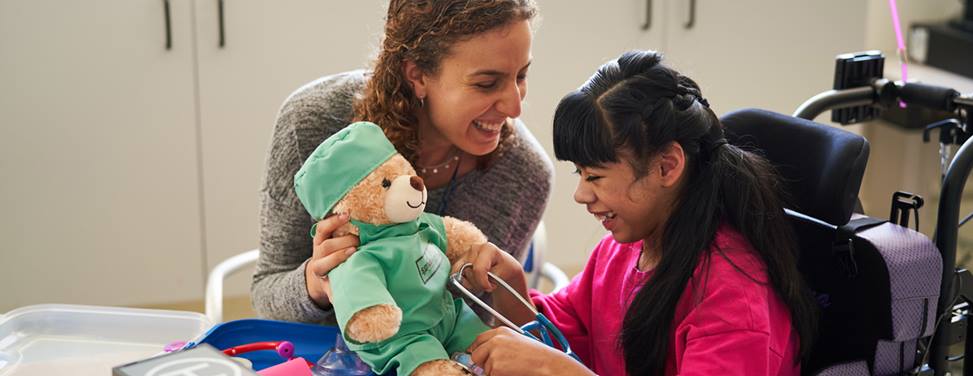
Our music therapy program nurtures patients with bedside serenades, rap workshops and more.
Find out more




Here to serve you
Explore our network of care for kids, from the tiniest to teens and young adults.




World-class docs
We'll help you find the best provider for your child.




Stress-free visits
Accommodations. Admission. Discharge. Procedure prep. We've got you covered.




Extraordinary kid care
Our specialists handle conditions ranging from the common to the most rare.




Referrals made easy
Contacts and resources to get your patients to our pediatric specialists




Best in Northern CA
We're ranked #1 in pediatric cancer, heart surgery, cardiology & more.





Neuroblastoma, an aggressive cancerous tumor affecting infants and young children, begins in the sympathetic nerve tissues, or the nerves responsible for the body's emergency "fight or flight" response. In the United States, about 600 children are diagnosed with neuroblastoma each year. It is the most common tumor found in children younger than 1 year of age.
Although these tumors may be present at birth, they often aren't detected until they've grown and compressed surrounding organs or have spread to lymph nodes, bones, the central nervous system or bone marrow. In rare cases, neuroblastoma can be detected before birth by a fetal ultrasound.
The tumor usually begins in the tissues of the adrenal glands, which are located in the abdomen on top of the kidneys. These glands secrete hormones and other important substances that are required for normal functions in the body such as the nervous system. The tumor also may begin in nerve tissue next to the spine in the neck, chest or pelvis.
To request an appointment, give us a call.
The most common symptoms of neuroblastoma are caused by pressure from the tumor or bone pain from cancer that has spread to the bone and bone marrow. Symptoms may include:
Other less common symptoms include:
Symptoms also may include:
If a child has symptoms of neuroblastoma, blood and urine tests, tissue samples, and imaging studies will be needed. These tests are important because many of the symptoms and signs of neuroblastoma also can be caused by other cancers or by non-cancerous diseases.
Normal nerve cells release chemicals called neurotransmitters that control nerve activity. Catecholamines are the main group of neurotransmitters produced by cells of the sympathetic nervous system. The body breaks down the catecholamine molecules into metabolites, or smaller pieces, and they are passed out of the body in the urine.
In about 90 percent of cases, neuroblastoma causes elevated levels of catecholamines or neurotransmitters, which are detected by blood or urine tests. Some of the symptoms associated with neuroblastoma — such as high blood pressure, rapid heartbeat or diarrhea — are caused by increased catecholamines.
Your child's doctor may order other blood tests to check liver and kidney function and salt balance. A urinalysis will be conducted to further check kidney function.
Imaging tests include diagnostic X-rays and other procedures that produce images or pictures of the body's interior. Two or more of these tests are generally used to identify tumors in areas where neuroblastomas tend to spread. These tests may include:
If blood or urine levels of catecholamines or their metabolites are elevated, then finding cancer cells in a bone marrow biopsy is sufficient evidence for a diagnosis of neuroblastoma. The disease spreads to bone marrow in about a quarter of patients.
Bone marrow can be sampled in two ways, and both are generally done at the same time. A bone marrow biopsy uses a large needle to remove a cylindrical piece of the bone about 1/2 inch long and 1/16 inch across. A bone marrow aspiration uses a thinner needle and a syringe to extract cells from the marrow, the soft tissue inside bone cavities.
Alternatively, tissue samples can be taken from the primary tumor. If examination under the microscope shows certain features typical of neuroblastoma, a definite diagnosis can be made, even if catecholamine levels are not elevated. Some cases of neuroblastoma are easily recognized under a microscope when examined by doctors experienced in testing children's tumor samples.
Other cases of neuroblastoma have features easily confused with other types of children's cancers. In these cases, special tests of the tissue samples must be done. For example, immunohistochemistry uses special laboratory antibodies that specifically recognize chemicals found in neuroblastoma cells and other antibodies that recognize chemicals of other cancer cells. Electron microscopy uses a special microscope hundreds of times more powerful than usual laboratory microscopes, and can recognize tiny packages of catecholamines inside neuroblastoma cells and other abnormalities.
When neuroblastoma is diagnosed, your child's doctor may use the following categories or terms to describe the cancer:
Treatment options are related to the age of your child, tumor location, stage of disease, regional lymph node involvement and tumor biology. More than one method of treatment may be used, depending on your child's needs.
Surgery is used when possible to remove as much of the cancer as possible. If the cancer can't be removed, surgery may be limited to a biopsy.
Radiation therapy uses high-energy rays to damage or kill cancer cells and shrink tumors. Radiation usually comes from a machine outside the body called external beam radiation therapy.
Chemotherapy is the use of drugs to kill cancer cells and shrink tumors. Chemotherapy drugs may be taken orally or injected into a vein or a muscle. Chemotherapy is called a systemic treatment because the drug enters the bloodstream, travels through the body and can kill cancer cells throughout the body. Chemotherapy may be given after the tumor has been surgically removed to kill any remaining cancer cells. This is called adjuvant chemotherapy. Chemotherapy also can be used to shrink the tumor before surgery. This is called neoadjuvant chemotherapy.
Bone marrow transplantation is a procedure in which healthy bone marrow is given to replace bone marrow destroyed by anti-cancer drugs or radiation. At UCSF Benioff Children's Hospital, the Bone & Marrow Transplant Program offers autologous bone marrow stem cell transplants to treat children with high-risk neuroblastoma. In this type of transplant, high-dose chemotherapy is given to kill the tumor. Bone marrow function is restored by infusing the patient's own bone marrow cells, which were previously removed and stored.
UCSF Benioff Children's Hospital is one of the few centers in the country to offer MIBG therapy for high-risk neuroblastomas that have not responded to chemotherapy, or have recurred after treatment. MIBG is a chemical that mimics certain natural compounds in the body that are concentrated in selective tissues, including neuroblastoma cells. MIBG can be attached to radioactive forms of iodine and given as an IV treatment.
Doctors at UCSF led a clinical trial of MIBG treatment for patients with resistant neuroblastoma. This treatment led to decreases in tumor size or number of tumor spots in approximately one-third of patients, making MIBG one of the most active drugs for these patients. In some patients, all of the tumor spots went away for a time.
MIBG therapy is only offered by entering a study or clinical trial because it is not yet FDA approved; UCSF conducts several MIBG therapy studies for the treatment of neuroblastoma and pheochromocytoma. The study a child enters will depend upon a number of factors, including open studies and their prior treatment.
One of the major side effects of MIBG treatment is low blood counts, or bone marrow suppression. Giving a dose of the patient's own stem cells can help to improve blood counts after MIBG treatment.
Sometimes MIBG is combined with chemotherapy or other medications. This may make neuroblastoma cells more sensitive to MIBG treatment. Your doctor will decide whether your child should be treated with MIBG alone or in combination with other medications. To learn more about MIGB therapy, go to mibg.ucsf.edu.
Radiation oncologists at UCSF have been pioneering the use of intraoperative radiation therapy (IORT) for some of the most difficult cases of neuroblastoma. UCSF is one of the few medical centers nationwide at the forefront of advancing this mode of treatment.
IORT delivers a concentrated beam of radiation to cancerous tumors while they are exposed during surgery. This allows high doses of radiation to be administered to tumors without exposing nearby healthy organs to radiation, lessening the risk that healthy tissue will be damaged.
Another advantage of IORT is that patients do not have to return for successive rounds of therapy after surgery. Those who receive the most common standard alternative, external beam radiation therapy (EBRT), typically receive treatment five days a week for several weeks. A single dose of IORT may have as much effect on the tumor as 10 to 20 daily radiation treatments.
Prior to IORT, oncologists treated the most aggressive cases of neuroblastoma with surgery, high doses of chemotherapy and some form of radiation. These high-dose treatments kill tumor cells more effectively. But the treatments also result in toxicities in many normal tissues, such as the death of bone marrow cells that make blood and immune cells. Thanks to these high-dose combinations of radiotherapy and chemotherapy, survival among neuroblastoma patients has improved greatly over the past two decades. Even so, among the 45 percent with high-risk tumors, the worst prognosis, only about one in three lives free of cancer regrowth for three years or more.
As described in the diagnosis section, neuroblastoma is categorized as localized resected, localized unresected, regional, disseminated and special.
Your child's treatment may be one of the following:
Initial treatment generally consists of surgery to remove as much of the cancer as possible, followed by chemotherapy. A second surgery may be performed to remove any cancer that remains. Radiation therapy also may be prescribed.
Treatment depends on your child's age. If your child is younger than 1 year of age, treatment may include the following:
If your child is older than 1 year of age, treatment may be one of the following:
Your child's treatment may be one of the following:
Children with this special type of neuroblastoma may not require therapy. You may want to have your child take part in a clinical trial that provides new methods of treatment.
The selection of treatment for recurrent or progressive neuroblastoma depends on the location and extent of the recurrence and previous therapy as well as individual circumstances. A clinical trial may be appropriate. UCSF Benioff Children's Hospital has available national and local studies for recurrent neuroblastoma, including new therapies with targeted radiation (I-131-MIBG), Phase I trials of the New Approaches to Neuroblastoma Therapy (NANT) consortium and Phase I and II trials of the Children's Oncology Group.
UCSF Benioff Children's Hospitals medical specialists have reviewed this information. It is for educational purposes only and is not intended to replace the advice of your child's doctor or other health care provider. We encourage you to discuss any questions or concerns you may have with your child's provider.
 3
3

A Study of Therapeutic Iobenguane (131-I) and Vorinostat for Recurrent or Progressive High-Risk...
Overall response (Yes/No) is based on the International Neuroblastoma Response Criteria (INRC, published 2017). The INRC will be calculated based on 123I-iobenguane scans, CT/MRI, and bone marrow biopsies and aspirates. A "Yes" is...
Recruiting
More about this study
Best in Northern California for cancer care
Ranked among the nation's best in 10 specialties

patients treated with MIBG therapy, a leading-edge neuroblastoma treatment
Soothing the soul