





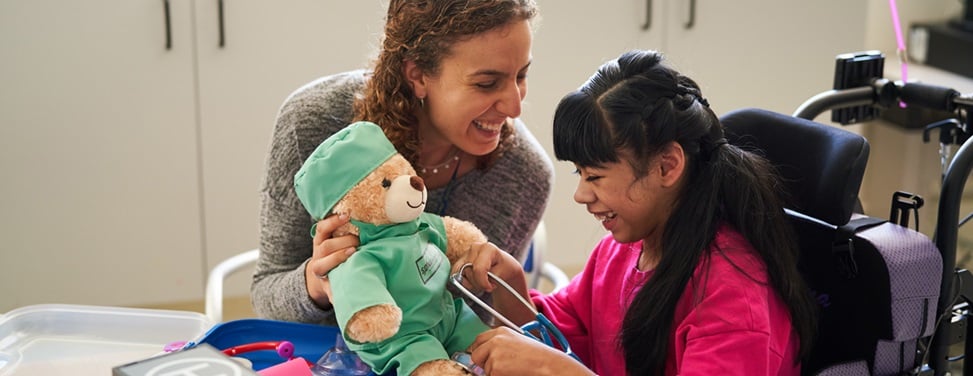






Translation, please
We have interpreters for Cantonese, Mandarin, Spanish, Russian, American Sign Language and more.
Request an interpreter




Here to serve you
Explore our network of care for kids, from the tiniest to teens and young adults.




World-class docs
We'll help you find the best provider for your child.




Stress-free visits
Accommodations. Admission. Discharge. Procedure prep. We've got you covered.




Extraordinary kid care
Our specialists handle conditions ranging from the common to the most rare.




Referrals made easy
Contacts and resources to get your patients to our pediatric specialists




Best in Northern CA
We're ranked #1 in pediatric cancer, heart surgery, cardiology & more.





Hodgkin's lymphoma is one of the two main types of lymphoma, a cancer that develops in the lymphatic system. The other type is non-Hodgkin's lymphoma. The difference between the two can be seen by looking at the cancer cells under a microscope. Hodgkin's lymphoma (also known as Hodgkin's disease) is characterized by the presence of a type of cell called a Reed-Sternberg cell.
Hodgkin's lymphoma typically starts in one or more groups of lymph nodes (small, bean-shaped organs that make and store cells that help fight infection), often in the neck. The first symptom is usually swollen lymph nodes.
Childhood Hodgkin's lymphoma is most common in adolescents between the ages of 15 and 19. While its exact cause is unknown, certain factors can increase a child's risk of developing this cancer. These factors include a family history of Hodgkin's lymphoma and past infection with the Epstein-Barr virus, a common herpesvirus found worldwide.
Top 10 in the nation and best in Northern California for cancer care
Ranked among the nation's best in 11 specialties

Accredited by the Foundation for Accreditation of Cellular Therapy
There are two main types of Hodgkin's lymphoma, classic and nodular lymphocyte-predominant.
This is the most common type. It has four subtypes, categorized by how the cells look under a microscope.
This type mostly affects children under 10. Typically, the only symptom is a swollen lymph node in the neck, armpit or groin.
The first sign of Hodgkin's lymphoma is usually swollen lymph nodes. Some children also have unexplained high fevers, weight loss and night sweats – symptoms that are more common when the cancer is extensive.
Many of the symptoms of Hodgkin's lymphoma in children can be caused by other conditions, such as infections. Nevertheless, if your child has any of these symptoms, they should be evaluated by their pediatrician.
Your child's doctor may order a number of tests, including imaging studies, such as a CT scan or PET scan. To confirm the diagnosis, your child will have a biopsy, which is the removal of a tissue sample to be examined microscopically for cancer cells.
Your child's doctor will choose the biopsy technique that best suits your child's condition. The goal is getting enough tissue to make an accurate diagnosis as quickly as possible while minimizing discomfort and the risk of complications. Biopsy options include:
The following stages are used for Hodgkin's lymphoma:
Stage 1
Cancer is found in just one of the following areas:
Stage 2
Cancer is found in at least two lymph node groups on the same side of the diaphragm (the thin muscle that separates the chest and abdomen).
Stage 3
Cancer is found in one of the following:
Stage 4
Cancer is found in one of the following:
The staging of Hodgkin's lymphoma may include the letters A, B, E or S, which signify the following:
A: The child is not experiencing fever, weight loss or night sweats.
B: The child is experiencing fever, weight loss or drenching night sweats.
E: The cancer is in an organ outside of the lymphatic system but it's near an affected area of the lymphatic system.
S: There is cancer in the spleen.
Recurrence
Recurrence is when cancer comes back after it has been treated. It may recur in the area where it first appeared or in another part of the body.
The most common treatments for Hodgkin's lymphoma are radiation and chemotherapy. Both may be parts of a single treatment plan. The right plan for your child depends on the cancer's stage and whether your child is fully grown. Your child may also be able to receive promising experimental treatments by participating a clinical trial.
The cure rate for children with stage 1 or 2 disease is about 90%. It's above 50% for those with widespread disease, even if the cancer is stage 4. After completing their treatment, children need to be monitored with regular exams and tests to check for signs of recurrent lymphoma and for long-term side effects of treatment.
Chemotherapy uses drugs to kill cancer cells and shrink tumors. It's called a systemic treatment because the drugs enter the bloodstream and therefore can kill cancer cells throughout the body.
Chemotherapy may be taken orally (as pills) or may be injected into a vein (intravenous administration) or into muscle. For types of lymphoma that spread to the brain, chemo can be injected into the fluid that surrounds the brain and spinal cord (cerebrospinal fluid).
Radiation therapy uses finely focused, high-dose X-ray beams to kill cancer cells. It's very effective in treating lymphoma.
If a patient's cancer becomes resistant to treatment with chemo or radiation, a bone marrow transplant (BMT), also called stem cell transplant, may be considered because it allows the use of very high doses of chemotherapy to treat the cancer.
These high chemo doses destroy bone marrow, so before the chemo course begins, some of the patient's marrow is taken from their bones. The marrow is frozen, and after the patient finishes the course of high-dose chemotherapy (with or without radiation therapy), their collected marrow is thawed and returned by needle into a vein so that it can replace the destroyed marrow.
Because the marrow comes from the patient, this type of transplant is called an autologous transplant (auto means "self" or "same"). If the marrow is donated by another person, the transplant is called an allogeneic transplant (allo means "other").
UCSF Benioff Children's Hospitals medical specialists have reviewed this information. It is for educational purposes only and is not intended to replace the advice of your child's doctor or other health care provider. We encourage you to discuss any questions or concerns you may have with your child's provider.
 2
2
Translation, please