





Translation, please
We have interpreters for Cantonese, Mandarin, Spanish, Russian, American Sign Language and more.
Request an interpreter




Here to serve you
Explore our network of care for kids, from the tiniest to teens and young adults.




World-class docs
We'll help you find the best provider for your child.




Stress-free visits
Accommodations. Admission. Discharge. Procedure prep. We've got you covered.




Extraordinary kid care
Our specialists handle conditions ranging from the common to the most rare.




Referrals made easy
Contacts and resources to get your patients to our pediatric specialists




Best in Northern CA
We're ranked #1 in pediatric cancer, heart surgery, cardiology & more.





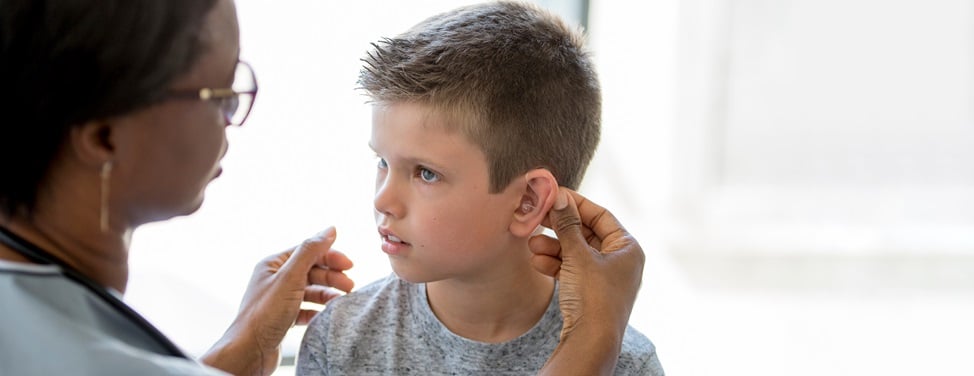
Many parents are concerned about their child's hearing, especially during the early years when infants can't communicate verbally. However, most children don't experience hearing problems. Three out of every 1000 newborns have hearing loss, which is often diagnosed during a routine hearing assessment they're given before leaving the hospital. Hearing loss can also develop later in life for various reasons, and your child's hearing can be evaluated at any age.
Hearing plays a critical role in child development, and even mild or partial hearing loss can affect a child's ability to speak and understand language. Detecting hearing loss early allows parents, teachers and doctors to better assist the child's development and assess corrective options.
There are three main types of hearing loss:
Review Signs of Normal Hearing to find a list of normal hearing behaviors and key signs to watch for as your child grows. If your baby isn't showing all the developmental signs of normal hearing, that doesn't necessarily mean he or she has a hearing problem, but it does mean an audiological evaluation should be performed.
If you have concerns about your child's responsiveness to sound, discuss your concerns with your pediatrician and request an evaluation by a hearing specialist, called an audiologist. Most importantly, trust your intuition. If you feel that something just "isn't quite right" about your baby's responsiveness to sound, talk to your pediatrician.
Children are evaluated for hearing loss based on developmental abilities. Various tests are available to assess:
The evaluation is tailored to each child to make the test as efficient as possible. The testing may include:
A few causes of hearing loss are treatable in infants and children. If a child has a temporary hearing loss due to an ear infection, fluid behind the eardrum or excessive wax in the ear canal, their pediatrician or an otolaryngologist (an ear, nose and throat specialist) can most likely treat the condition successfully. Other cases of hearing loss are caused by problems with the bone structures in the middle ear, and these can sometimes be treated surgically when the child is older, around 7 to 9 years old.
Sensorineural hearing loss, which is typically permanent hearing loss that's caused by a disorder affecting the cochlea or the auditory nerve, usually can't be treated with medication or surgery. However, it can be managed successfully with help from an audiologist and other experts. In addition, it's imperative that doctors fully evaluate children with hearing impairment for other disorders, including visual or kidney defects.
There are many options in managing permanent hearing loss, and your audiologist will provide you with information and resources to help you make the best decisions for your child. Some of these options include:
There's no one correct choice when it comes to managing your child's hearing loss. Our pediatric audiologists will help you make choices with all the information possible. It's important to remember that the choices you make for your child may change as your child develops.
Hearing aids and cochlear implants are two options available for some children, depending on their degree of hearing loss.
In general, children with mild to severe hearing loss are candidates for using hearing aids. Children with severe to profound hearing loss who don't benefit enough from hearing aids may be candidates for a cochlear implant.
UCSF Benioff Children's Hospitals medical specialists have reviewed this information. It is for educational purposes only and is not intended to replace the advice of your child's doctor or other health care provider. We encourage you to discuss any questions or concerns you may have with your child's provider.

Preschool Hearing Screening
Percentage of children identified with hearing loss; (number of children identified with hearing loss) / (number of all screened children)
Recruiting
More about this study
Ranked among the nation's best in 11 specialties
Translation, please