
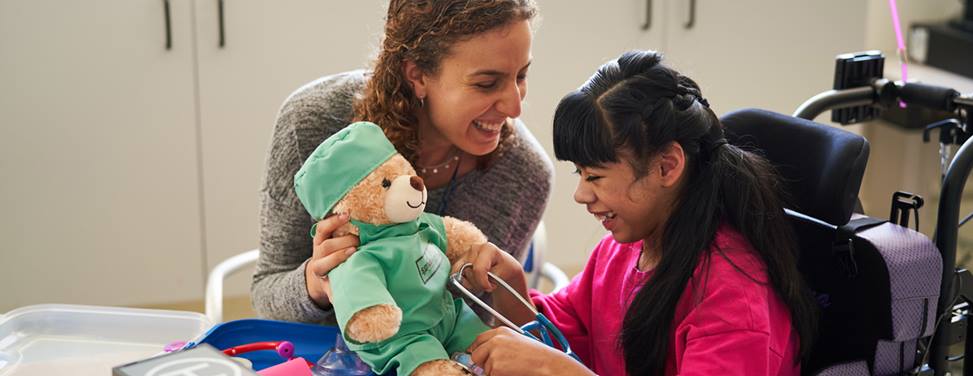




Feeling at home
From bedside bingo to therapy dogs, we're here to help kids smile and feel more like themselves.
Visit Child Life services




Here to serve you
Explore our network of care for kids, from the tiniest to teens and young adults.




World-class docs
We'll help you find the best provider for your child.




Stress-free visits
Accommodations. Admission. Discharge. Procedure prep. We've got you covered.




Extraordinary kid care
Our specialists handle conditions ranging from the common to the most rare.




Referrals made easy
Contacts and resources to get your patients to our pediatric specialists




Best in Northern CA
We're ranked #1 in pediatric cancer, heart surgery, cardiology & more.





Hydrocephalus — from "hydro," the Greek word for water, and "cephalus," the Greek word for head — occurs when abnormal amounts of cerebrospinal fluid accumulate in the brain's cavities, called subarachnoid space.
Acquired hydrocephalus occurs after birth when a tumor, injury or disease blocks the absorption of cerebrospinal fluid in the brain. Babies may also be born with hydrocephalus, called congenital hydrocephalus. Affecting one out of every 1,000 newborns, congenital hydrocephalus is caused by a brain malformation or birth defect.
Cerebrospinal fluid, or CSF, is a clear, colorless liquid that normally surrounds the brain and spinal cord, protecting them from injury, bringing them nutrients and taking away waste. In a healthy person, all CSF produced by the brain is absorbed by the body. In hydrocephalus, the fluid fails to drain and accumulates, creating pressure on the brain.
A build-up of CSF may result from one of three reasons:
Acquired hydrocephalus is caused by injuries or conditions that develop after birth, such as a hemorrhage, meningitis, head trauma, tumors and cysts.
Symptoms in older children may include:
During your visit to UCSF Benioff Children's Hospital, our doctors and other staff members will thoroughly evaluate your child. We will ask you about your child's medical history as well as the medical history of your immediate family.
If your pediatrician has sent us your child's medical records, we will review this information as well. Be sure to tell your child's doctors about medications your child is currently using, including over-the-counter medications, vitamins, nutritional supplements and herbal remedies.
Hydrocephalus is assessed by measuring its effect on the brain. If cerebrospinal fluid builds up, it frequently leads to enlarged cavities visible on diagnostic scans of the head.
Your child's evaluation will include imaging tests such as:
To determine the best treatment, it's sometimes necessary to measure pressure within your child's skull. This measurement is made by placing a small monitor beneath the skull during a short surgical procedure.
Acquired hydrocephalus is most commonly treated by either removing the cause of the condition, such as a tumor or other blockage, or inserting a shunt. The shunt is a flexible plastic tube that diverts excess cerebrospinal fluid from the brain to the abdomen where it can be absorbed back into the body. A valve within the shunt regulates and prevents excessive drainage.
A limited number of patients can be treated with an alternative procedure called endoscopic third ventriculostomy, or ETV. In this procedure, a small hole is made in the floor of the third ventricle of the brain, one of the brain's four cavities. This allows the cerebrospinal fluid to bypass the obstruction and flow toward an area where it can be reabsorbed by the body.
If you have questions about your child's treatment, feel free to ask your child's doctors, nurses and therapists. If the treatment includes medication, be sure that your child takes it exactly as instructed. Remember to bring your child to all follow-up appointments.
Your medical team will explain possible risks or complications from these treatments. You may be referred to additional doctors or other medical professionals.
Hydrocephalus can pose risks to both mental and physical development, but many children diagnosed with this disorder benefit from rehabilitation and educational programs and go on to lead normal lives.
UCSF Benioff Children's Hospitals medical specialists have reviewed this information. It is for educational purposes only and is not intended to replace the advice of your child's doctor or other health care provider. We encourage you to discuss any questions or concerns you may have with your child's provider.

Patient education
This lifesaving device stops cerebral spinal fluid (CSF) from building up in the brain by diverting it to another part of the body, where it can be safely absorbed. Find out how it does its job – and how to make sure your child’s is working properly.

Patient stories
When Brock Albee was 3 years old, a scary accident at day care led to a diagnosis of hydrocephalus, a fluid buildup in the brain. UCSF doctors have been treating him for more than 20 years and counting – with amazing results.
 9
9
 8
8

One of the nation's best in neurology & neurosurgery

in NIH funding among U.S. neurology programs

Ranked among the nation's best in 10 specialties
Feeling at home